2006 French IPv6 Worldwide Summit
Archived Content
IPv6 has been in the works since 1998 to address the shortfall of IP addresses available under Ipv4. IPv6 is the latest version of the Internet Protocol, which identifies devices across the internet so they can be located. Every device that uses the internet is identified through its own IP address in order for internet communication to work. In that respect, it’s just like the street addresses and zip codes you need to know in order to mail a letter.
In 2006 French IPv6 Worldwide Summit was held to address a number of issues related to IPv6's role in un-locking web based networks to meet their full potential. This was their website for the conference.
Content is from the site's archived pages as well as from other sources.

ETSI supports key IPv6 event
Sophia Antipolis, 18th October 2006 / www.etsi.org
As demand for the protocol grows, the French IPv6 Worldwide Summit - 14th to 15th November 2006, Cannes, France - will consider strategies for Deployment, Address management, Domain name management and other issues related to IPv6's role in un-locking web based networks to meet their full potential.
ETSI will be present as speaker, test partner and exhibitor at the Summit. This meeting of the Internet and the Telecommunications world is highly significant, as it emphasises the increased interest and understanding between the communities as steps are taken towards converged networks.
With International participation from Government, Industry and Research, this event promises to be an important contributor to the IPv6 roadmap.
Important themes:
- IPv6 GOVERNANCE: RIRs - PANEL SESSION
- DEPLOYMENT IN GOVERNMENTAL AGENCIES
- OPERATORS & ISPs DEPLOYMENT
- DEPLOYMENT IN THE EDUCATION SECTOR & REGIONAL ENVIRONMENT
- APPLICATIONS & SERVICES
- VENDORS ROADMAP AND VISION
- SECURITY AND EQUIPMENT CHALLENGES
- TEST & CERTIFICATION
- NETWORK MANAGEMENT
- IPv6 IN THE CONTEXT OF MOBILITY: ROADMAP & ISSUES
A 'hands-on' tutorial will take place on the 16th November - at the same location - with 100 PCs connected to give participants first-hand experience of the new capabilities of the IPv6 protocol, putting into practice its essential elements (network configuration, IPv6 routing, network management and IPv6 programming).
To measure against the promises made in the conference, ETSI PlugtestsTM will provide a test bed for manufacturers and developers bringing IPv6 products to test towards 'IPv6 Ready' labelling.
Registration is now open for the French IPv6 Worldwide Summit and also for the tutorial and ETSI PLUGTESTSTM interoperability event.
Serving as one of the organizers who consulted on the summit, I’ve spent a lot of time reflecting on what the site captures so well: the ambition, the intellectual seriousness, and the sense that people from government, research, and industry were genuinely trying to build the Internet’s future together.
When I revisit the materials, I’m reminded of how enormous the undertaking felt. We were coordinating speakers from multiple continents, aligning technical demonstrations, and supporting ETSI’s involvement as speaker, exhibitor, and test partner. The program had depth—governance, deployment, security, mobility, education, defense—and every track had stakeholders who believed their topic was the key to making IPv6 real.
What the website can’t fully show, but anyone who has organized events at this level will understand, is how often creative decisions are shaped—or reshaped—by politics.
In the early planning meetings, our team had a very clear vision. We wanted a venue that matched the international, forward-looking energy of the program. We had a design direction for the printed materials, a shortlist of caterers who could handle the multicultural audience, and a media plan built around a photographer whose work we trusted to humanize what might otherwise feel like a highly technical gathering.
Then the funding realities arrived.
The financial backers had relationships. Partners had properties. Vendors had alliances. One by one, elements we thought were locked began to move. The venue changed because a sponsor preferred a hotel owned by an associate. The caterer changed for similar reasons. Even the color scheme of the brochures became a negotiation because certain tones aligned better with institutional branding.
If you’ve ever heard the phrase “too many chefs in the kitchen,” you already know how this part of the story goes.
And yet—here’s the interesting thing—it still worked.
Where we held firm, and where I’m personally grateful we did, was in keeping Rue Sakayama as the portrait photographer.
There was pressure to replace her with someone from a sponsor’s network. Schedules were floated, alternatives proposed, introductions made. In the end, that replacement photographer became unavailable, and the path cleared again for Rue. It felt accidental at the time, almost like a last-minute compromise, but looking back it was essential. Her ability to capture the humanity of delegates—engineers debating routing, policymakers greeting counterparts, exhausted organizers sharing coffee between sessions—gave the summit a visual memory that matched its intellectual weight.
Politics can interfere with creative direction, yes. It can dilute, delay, complicate. But it can also force organizers to become sharper negotiators and better diplomats. It pushes you to articulate why a choice matters, where flexibility is possible, and where it isn’t.
The summit taught me that successful events are rarely pure expressions of the original plan. They are living compromises among vision, funding, logistics, and personalities.
I’m proud of what we accomplished. I’m proud that the substance survived the politics. And I carry forward a lesson I’ve used in every event since—invite stakeholders to the table, but keep someone responsible for guarding the core purpose. Otherwise the kitchen fills up fast.
In the end, we adapted, we delivered, and thanks to the documentation preserved on the site, the effort—and the balancing act behind it—won’t be forgotten. Desmond Chaskel

Framework &Goals
IPv6 is the next generation Internet. It gives vastly increased address space and true end-to-end communication. It has improved security and mobility features and allows 'plug-and-play' connection to the network.
The complexity of implementing IPv6 technology and the relative openness of IETF standards means that wide-ranging and effective testing of IPv6 products will be one of the key factors in ensuring the deployment, interoperability, security and reliability of the IPv6 infrastructure on which the success of e-Government, e-Business, e-Health, e-Learning and e-Procurement will eventually depend.
The key objective and benefits of the ETSI IPv6 Plugtests event were:
- Access in one place a wide range of tests provided by various test companies
- Check the interoperability of products with those of international and active market players
- Run the tests of the IPv6 Ready Logo phase-1 and Phase-2.
- Improve and debug IPv6 implementations by:
-
running the available Interoperability and Conformance tests
-
running the TTCN-3 tests.
-
This Plugtests was organised in partnership with:
French IPv6 Worldwide Summit- Post event editorial
By Tayeb Ben Meriem
President of French IPv6 Worldwide Summit Program Committee
The French IPv6 worldwide Summit, organized by the French IPv6 Task Force in cooperation with the European Telcommunications Standards Institute (ETSI), was held on November 14-15 in Cannes and was an enormous success. The summit attracted more than 150 attendees of which European 70%, Asian 20% and American 10%.





Three key events were organised:
-
2 days of conferences with noted global IPv6 specialists from varying market sectors and regions
-
An IPv6 tutorial that was both theoretical and practical. This included the setting up of approximately one hundred computers on a network.
-
The annual IPv6 worldwide interoperability event (ETSI's Plugtests).
We enjoyed an update of the IPv6 strategies of the most advanced regions (Europe, the United States, and Asia). Noted, prestigious representatives within the IPv6 world presented these. They also participated in the Programme Committee and opening sessions as "keynote speakers".
They set out a panoramic view of the strategic positions of IPv6 worldwide, in particular within Europe, the United States, and Asia (China, Korea, Japan and India). We are pleased to report that the result of IPv6 policies and plans in the various regions (Japan, China, Korea, India, Europe) launched during the last five years remains encouragingly, positive.
New plans are launched since 2005.
From the European Commission’s perspective, after the "eEurope 2005" initiative, Commissioner Viviane Reding launched, a new initiative entitled "i-2010” in 2005. Ulf Dahlsten, Director of the emergent technologies and infrastructure, presented a roadmap and precise orientation for the deployment of IPv6 in Europe, during the summit.
From India, Hemanth Dattatreya, Vice President of the Indian IPv6 Forum, announced for the first time, two major decisions concerning the deployment of IPv6 in India.
-
The creation of an IPv6 Interoperability and Testing Logo ready Centre in partnership with Telecom Engineering Center, DIT/MCIT.
-
The setting up of the "India-6 Advanced Internet (I6) consortium. This is aimed at generalising the deployment of IPv6 (Networks and Services) in India.
As a Case study within the education sector perspective, we shared the "Greece Schools" experience. This is now a major European reference site, where more than 3000 schools are connected via IPv6 in Greece. This network has now gained widespread acceptance in various European countries.
We also presented the French Case Study of Gonfreville, which is viewed under the concept of "the electronic School" and the "electronic Schoolbag". It consists of two Elementary schools and one High School.
The connectivity of IPv4 and IPv6 is assured, by the regional education network of Normandy, branded "SYRHANO" which is a pioneer in IPv6 in France within the education sector.
In this session, the African region was also represented. The most advanced IPv6 African country is South Africa. Dr Duncan presented the TELNET's IPv6 network (Education & research Network) as well as his extension in the main border countries of South Africa. This network is linked to both the European (GEANT), and American (ABILENE), Education and Research networks.
On a general note, there has been the creation of the African regional Internet register "AfriNic" in 2004. With a second objective of disseminating IPv6, this is a strong instrument aiming at integrating this region into global IPv6 activities.
Moreover, we also wanted, in this session, to focus on another governmental sector, Defence, that constitutes of a tremendous IPv6 driver and trigger for other sectors.
The high level of the speakers (Colonels) in this session testifies to the commitment of the various NATO Ministries of Defence in IPv6. After the DoD's IPv6 Roadmap "2003-2008", most of the Ministries of Defence of the European countries adopted the same strategy.
From operators & ISPs perspective, ATT, Comcast, Teleglobe, CNGI, NTT, KT, CHT, BT, FT set out their IPv6 strategies, roadmaps, and development plans. This segment is clearly moving.
Regarding the applications, the Summit highlighted that the Emergency & Crisis management user case is now at the heart of the strategies in Europe with u-2010 project, Metronetv6 in the US, Live E in Japan and we hope such a wave will lead to a worldwide cross-organisation.
On the Management and security side, a lot of progress needs to be done however; much work is ongoing from commercial and operational perspective in order to meet operators and ISPs requirements.
After the Summit, we arranged a programme of visits to the Chinese delegation with the European Commission, French competitiveness clusters, academic institutions and manufacturers, to initiate collaborations or reinforce those that the Ministry of Industry had already put in place regarding IPv6.
Besides, we organised during the Summit a ceremony aiming for a signature of a MoU on IPv6 between France and India.
Indeed, the French Ministry of Industry set up a joint Workgroup "France-India" on ICTs. This Workgroup is in charge of declining concretely the framework agreement of cooperation signed between the French Ministry of Industry and his Indian counterpart (MCIT).
The 5th meeting of this Workgroup was held on September 19th and 20th in the French Ministry of the Economy gave place to a statement of decision a point of action of which is the signature of a MoU on IPv6 between French Task Force IPv6 and the Indian Forum IPv6 during the Summit IPv6 of Cannes.
The signatories of the MoU are: For India’s side, the VP of IPv6 Forum India, Mr. Hemanth Dattatreya and for France, Tayeb Ben Meriem, the VP of thee French IPv6 Task Force.
All the presentations of the Summit are in the portal highlighting an interesting research survey from industry, government and operators perspective.

FAQ
- What is a Plugtests TM Event?
Plugtests refers to event where engineers get together to test the interoperability of their implementations between each other.- Plugtests are part of the standardization process.
- The implementations tested may be prototypes or products ready for commercialization
- The events are open to every developers
- The events are usually of short duration (1-5 days)
- They take place within the time frame of the standards drafting or shortly after its completion
-
What is the goal of a Plugtests TM Event?
The aim is Interoperability. This is what standards are all about. Plugtests increase the probability of achieving interoperability by debugging the standard and companies’ implementations at an early stage.
- What happens during a Plugtests TM Event?
Plugtests are for engineers who are implementing a standard. They are not for people who just want to see what the competition is working on. Plugtests are also not trade shows. So care needs to be taken that only engineers with implementations attend.
- It seems that pretty sensitive information may be revealed at Plugtests. Doesn’t this risk outweigh the benefits?
The fact that companies do go to these events demonstrates that, at least for those companies, risk outweighs benefits. We put this question to the participants, on a scale of 1 (risks outweighs benefits) to 5 (benefits outweighs risks), the total average score of about 70 events is 4.2.
- Aren’t interoperability events benefiting only small companies?
No. The question assumes – wrongly – that a small company has an implementation which is inferior to that of a big company.
- Aren’t Plugtests benefiting only non-experienced companies, i.e. companies that are just starting to implement the standard, over experienced companies?
That’s precisely the reason why the time-window for such event is rather short, i.e. only as long as the standard is still in the making. As soon as there is a general understanding on how to interpret a standard, there is no more incentive for the experienced player to participate in Plugtests and give newcomers lessons for free.
- Is a Plugtests Event only for equipment manufacturers?
Most of the participants are equipment manufacturers (vendors). But often operators are experimenting with the standard as well, writing their own implementations to get a better understanding of the standard and of potential problems.
- What are the BENEFITS of a Plugtests?
The events help to enhance the quality of a standard in the making. Plugtests find errors or ambiguities in standards and thereby help improve the quality of standards.- Fast feedback into the standards process
The earlier bugs are discovered, the cheaper it is to correct them. To start writing conformance test specifications, the standard has to be quite mature. Also, the process of generating Abstract Test Suites does take some time. Plugtests take place early in the standards process and therefore allow fast feedback on possible errors or ambiguities in the specification. Engineers say that these events definitely speed up the process of bringing products to the market. - Increased circle of participants - developers are active in the process.
- Close interaction and cross fertilization between the people drafting and those implementing the standard is beneficial for the quality of the standard.
- Plugtests gauge the market acceptance of a standard.
- Publicity of Plugtests will raise awareness in the market about the standard.
- Debugging a vendor’s implementation
Testing against products of other companies, engineers find errors in their implementation that they would not have found otherwise, or only much later. - Meeting other developers familiar with the standard
By making personal contact with developers of other companies and getting to know them, questions and answers that one doesn’t want to post on a public mailing list can be exchanged after the event. - Overall, Plugtests save companies and the industry lots of time and money.
Engineers rank the usefulness of these events consistently very high. In addition to discovering problems, these events allow testing with a wide range of vendors in a short amount of time. According to participants, much time and money is therefore saved as opposed to one-on-one scheduling.
- Fast feedback into the standards process
- What do Plugtests have to do with standardization?
They take place while the standard is still in the making. As long as there are changes to the standard, there will be interest in Plugtests. Once the standard has settled, participation at Plugtests may drop until new certification releases are introduced.
In contrast, interoperability testing as done by e.g. test houses or network operators comes later in the process, i.e. when the implementation is about to be ready for the mass market.
- How can Plugtests enhance the quality of specifications?
Plugtests take place early in the process, namely while the standard is still being drafted. They don’t guarantee interoperability, but they increase the probability of interworking. They enable the identification of areas for improvements, errors and ambiguities within the standard.
- Don't well written standards make Plugtests superfluous?
The better standards are written with few options, the easier it is to achieve interoperability. Good standards don’t make Plugtests superfluous, but good standards necessitate fewer of them.
- Are Plugtests something new?
No, Plugtests have been around for many years, though less in the telecommunications world. They are also known as "Plugfests", "Interoperability events", "Group tests" and "IOP".
AGENDA
|
|
||||||||||||||||||||||||||||||||||||||||||||||||||||||||||||||||||||||||||||||||||||||||||||||||||||||||||||||||||||||||||||||||||||||||||||||||||||||||||||||||||||||||||||||||||||||||||||||||||||||||||||||||||||||||||||||||||||||||||||||||||||||||||||||||||||||||||||||||||||||||||||||||||||||||||||||||||||||||||||||||||||||||||||||||||||||||||
|
||||||||||||||||||||||||||||||||||||||||||||||||||||||||||||||||||||||||||||||||||||||||||||||||||||||||||||||||||||||||||||||||||||||||||||||||||||||||||||||||||||||||||||||||||||||||||||||||||||||||||||||||||||||||||||||||||||||||||||||||||||||||||||||||||||||||||||||||||||||||||||||||||||||||||||||||||||||||||||||||||||||||||||||||||||||||||
HOTEL INFORMATION
All events for the French IPv6 Worldwide Summit (Conference, Tutorial & Plugtests) took place at the Sofitel Royal Casino Hotel.
Sofitel, Cannes-Mandelieu Royal Casino Hotel.
605 Avenue du Général de Gaulle - BP 49
Mandelieu La Napoule Cedex
FRANCE
Tel: +33 (0)4 92 97 70 00
Fax: +33 (0)4 93 49 51 50
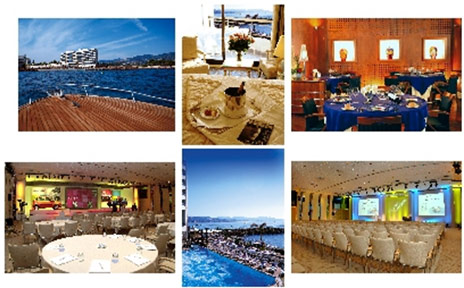
Opposite the famous Cannes Bay and ideally located on the sea front, 10 minutes from the Croisette Avenue and the Palais des Festivals, 5 minutes from Cannes-Mandelieu airport and 30 minutes from Nice Côte d'Azur airport.
200 rooms & suites overlooking the sea or the golf course. 2 restaurants opposite the beach to include the famous Le FEREOL which provides an outstanding view on the bay of Cannes with its veranda overlooking the sea. It features Provencal & Mediterranean specialities, as well as a selection of fishes and a buffet. The hotel also has a piano bar, meeting rooms (1,000 people), night club, private beach, sauna, Turkish bath, tennis courts and Royal Casino with 200 slot machines & table games.
Opposite the famous Cannes Bay and ideally located on the sea front, 10 minutes from the Croisette Avenue and the Palais des Festivals, 5 minutes from Cannes-Mandelieu airport and 30 minutes from Nice Côte d'Azur airport.
200 rooms & suites overlooking the sea or the golf course. 2 restaurants opposite the beach to include the famous Le FEREOL which provides an outstanding view on the bay of Cannes with its veranda overlooking the sea. It features Provencal & Mediterranean specialities, as well as a selection of fishes and a buffet. The hotel also has a piano bar, meeting rooms (1,000 people), night club, private beach, sauna, Turkish bath, tennis courts and Royal Casino with 200 slot machines & table games.
Rooms include:
|
|

More Background On V6Summit.com
V6Summit.com served as the official online portal for the 2006 French IPv6 Worldwide Summit, an international conference dedicated to accelerating the global deployment of Internet Protocol version 6 (IPv6). Held in November 2006 in Cannes-Mandelieu, France, the summit gathered policymakers, telecommunications operators, standards bodies, research institutions, defense officials, and technology vendors at a critical moment in the evolution of the Internet.
At the time, IPv6 was widely regarded as essential to sustaining Internet growth beyond the limitations of IPv4. V6Summit.com documented the summit’s agenda, leadership, international collaborations, interoperability testing initiatives, and strategic roadmap discussions. Although the site now survives primarily through archived versions, it provides a detailed record of one of Europe’s most significant early IPv6 policy and deployment gatherings.
The Global Context in 2006: Why IPv6 Was Urgent
By 2006, experts across industry and government understood that IPv4’s address space—approximately 4.3 billion addresses—would not be sufficient to sustain global Internet expansion. Broadband adoption was accelerating. Mobile data networks were growing. Governments were digitizing services. Early machine-to-machine and embedded systems deployments were emerging.
IPv6, standardized through the Internet Engineering Task Force (IETF), introduced a 128-bit addressing architecture capable of supporting an astronomically larger address space. Beyond address expansion, IPv6 offered:
Stateless address autoconfiguration
Native support for IPsec security
Improved routing aggregation
Enhanced mobility features
Restoration of end-to-end connectivity
By the mid-2000s, IPv6 was no longer theoretical. Governments in Asia and Europe had launched national IPv6 strategies. Equipment vendors were implementing dual-stack capabilities. Telecom operators were testing deployment models. The 2006 French IPv6 Worldwide Summit positioned itself as a coordination point for these efforts.
Ownership, Organizers, and Institutional Backing
The summit was organized by the French IPv6 Task Force in cooperation with European Telecommunications Standards Institute (ETSI). ETSI, headquartered in Sophia Antipolis, France, has long played a central role in telecommunications standardization within Europe and internationally.
The program committee was chaired by Tayeb Ben Meriem, a leading figure in France Telecom’s IPv6 R&D initiatives. Additional leadership roles were held by senior members of the IPv6 Forum and other international IPv6 task forces.
The event’s institutional backing reflected a convergence of:
National governments
Regional Internet Registries
Defense ministries
Academic research networks
Telecommunications operators
Global equipment manufacturers
The summit was not a commercial trade show but a strategic multi-stakeholder policy and deployment forum.
Venue and Geographic Significance
The summit took place at the Sofitel Cannes-Mandelieu Royal Casino Hotel in Mandelieu-La Napoule, near Cannes on the French Riviera. Its proximity to the Palais des Festivals and major regional airports provided convenient international access.
Hosting the event in Cannes reinforced its international stature. Cannes is globally associated with large-scale events—film festivals, industry summits, and global conferences. By situating the IPv6 summit there, organizers aligned the technical transition of Internet infrastructure with a setting known for high-profile international gatherings.
Structure of the Event
The summit spanned three primary components:
Two days of conference sessions
A hands-on IPv6 tutorial
The ETSI Plugtests interoperability event
This structure underscored the summit’s dual nature: strategic policy alignment and practical engineering validation.
Two-Day Conference Program
The conference featured parallel tracks covering:
Governance and Regional Internet Registry policy
Governmental agency deployment
Operators and ISP roadmaps
Education and research network adoption
Applications and services
Vendor vision and equipment readiness
Security and network management
Test and certification
Mobility and 3G/4G integration
Speakers represented institutions from Europe, North America, Asia, and Africa.
International Participation and Geopolitical Scope
Attendance reportedly exceeded 150 participants, with representation approximately divided as:
70% European
20% Asian
10% North American
The geographic diversity of speakers was notable. Countries and regions represented included:
France
Germany
Italy
Poland
United Kingdom
United States
Japan
China
Korea
India
Taiwan
South Africa
Egypt
Turkey
This distribution reflected the global race to establish leadership in IPv6 deployment during the early 2000s.
Asia, in particular, was moving aggressively. Japan had launched large-scale IPv6 research initiatives. China’s CNGI project was expanding IPv6 backbone capabilities. India was forming IPv6 interoperability and testing centers.
Governance and Address Policy Discussions
One major track focused on IPv6 governance and address allocation. Speakers included representatives from:
ICANN
American Registry for Internet Numbers
RIPE NCC
AFNIC
These discussions addressed:
Regional IPv6 allocation policies
Global coordination among RIRs
Local Internet Registry responsibilities
Naming and addressing resource management
The summit emphasized that IPv6 deployment was not purely technical; it was inherently linked to governance structures and international coordination.
Defense and Governmental Agency Deployment
A significant segment of the program addressed governmental and defense adoption.
Representatives from NATO-aligned ministries of defense presented IPv6 transition roadmaps. The U.S. Department of Defense had already published an IPv6 roadmap (2003–2008), influencing allied nations.
Defense adoption was seen as a strategic driver. Military networks require:
End-to-end encryption
Secure mobility
Scalable addressing
Interoperability across multinational operations
By including high-ranking military officials and defense technologists, the summit reinforced IPv6 as critical national infrastructure rather than optional innovation.
Operators and ISP Roadmaps
Telecommunications operators shared deployment strategies, including representatives from:
AT&T
Comcast
France Telecom
NTT Communications
British Telecom
Chunghwa Telecom
Korea Telecom
These presentations covered:
Dual-stack deployment models
Backbone upgrades
Customer premises equipment readiness
Enterprise transition strategies
Traffic engineering and QoS considerations
The operator track demonstrated that IPv6 was transitioning from lab experiments to production networks.
Education and Research Network Adoption
National research and education networks (NRENs) were early adopters of IPv6.
Case studies included:
Greek School Network (connecting thousands of schools)
French regional education networks
South Africa’s TENET
European research backbone collaborations
These examples highlighted the role of academia as a testing ground for new protocols. Education networks often adopt emerging standards earlier due to their research mandates and experimental flexibility.
Applications and Services: Beyond Infrastructure
A dedicated track examined applications enabled by IPv6, including:
Home networking
Automotive telematics
Emergency and crisis management systems
Surveillance systems
Smartcard networking
Mobility integration
IPv6’s expanded addressing and mobility capabilities were framed as enabling entirely new categories of applications. In particular, crisis management systems in Europe and Asia were cited as high-priority deployment scenarios.
ETSI Plugtests: Interoperability in Practice
A central pillar of the summit was the ETSI Plugtests event.
Plugtests are structured interoperability testing sessions where engineers bring implementations—often prototypes—and test them against other vendors’ products. These events occur while standards are still evolving, allowing ambiguities or incompatibilities to be identified early.
Benefits highlighted included:
Early debugging of implementations
Faster time-to-market
Direct feedback into standards drafting
Reduced long-term deployment risk
Participants consistently rated Plugtests highly in terms of usefulness. The 2006 event included IPv6 Ready Logo testing and TTCN-3 conformance tests.
This practical engineering focus distinguished the summit from purely policy-driven events.
Vendor Roadmaps and Technology Vision
Equipment vendors presented forward-looking IPv6 strategies. These included:
Cisco Systems
Hewlett-Packard
Nokia
Zyxel
Alcatel
Siemens
Hitachi
Vendor presentations addressed:
Firmware and router upgrades
Network management systems
Security architecture
Mobility support
Quality of service
The vendor track underscored that IPv6 readiness required alignment across hardware, software, and operational management systems.
Security and Network Management
Security sessions examined IPv6 threat models and deployment challenges. Although IPv6 included mandatory IPsec support, real-world implementation raised operational complexities.
Topics included:
Threat modeling for IPv6 networks
Renumbering safety
NetFlow/IPFIX standardization
Monitoring frameworks
QoS integration
The summit acknowledged that IPv6 deployment introduced new operational variables that required careful management.
Diplomatic and Policy Outcomes
Beyond technical sessions, the summit facilitated diplomatic engagement. Notably:
A Memorandum of Understanding (MoU) on IPv6 cooperation was signed between French and Indian IPv6 organizations.
Delegations engaged in post-summit visits to strengthen collaboration.
African IPv6 coordination efforts were highlighted following the establishment of AfriNIC.
These outcomes demonstrate that the summit functioned as a platform for international technology diplomacy.
Cultural and Strategic Significance
While IPv4 exhaustion would not occur until 2011, the 2006 summit captured a moment when forward-looking policymakers and technologists were attempting to preempt crisis.
The summit reflected:
Europe’s proactive digital policy initiatives
Asia’s rapid infrastructure modernization
Defense-driven urgency
Academia’s experimental leadership
Vendor-market alignment efforts
It stands as a case study in coordinated global standards transition.
Popularity, Reach, and Historical Value
Although attendance was modest by modern standards, the summit’s influence lay in its composition: senior policymakers, defense officials, registry executives, operators, and standards leaders.
Today, V6Summit.com holds archival value as documentation of early structured IPv6 deployment efforts. Its preserved agenda reveals the depth of planning and coordination that preceded IPv4 exhaustion.
V6Summit.com represents more than a conference website. It is a historical record of how the global Internet community mobilized to address structural limitations before crisis struck.
The 2006 French IPv6 Worldwide Summit illustrates:
The interplay between governance and engineering
The role of defense and government in protocol adoption
The importance of interoperability testing
The strategic foresight of early IPv6 advocates
In retrospect, the summit can be viewed as part of the foundation that enabled the eventual global IPv6 rollout. It captures a transitional era when Internet infrastructure evolution required not just technical innovation, but international coordination, political alignment, and institutional commitment.
